
My Tutor Couldn’t Use a Computer. He Taught Me Everything Important
My Tutor Couldn’t Use a Computer. He Taught Me Everything Important
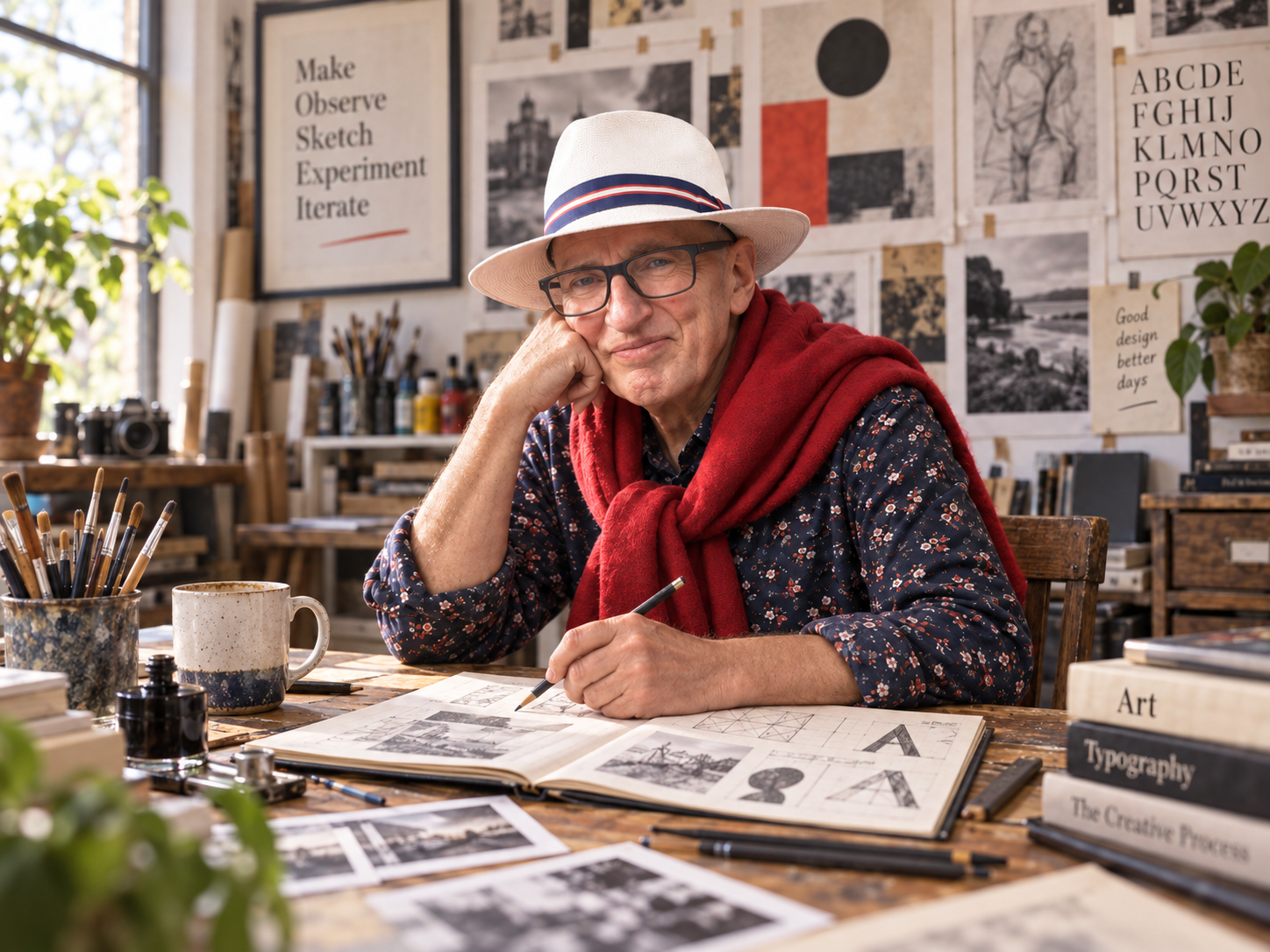
When I was learning graphic design, one of my tutors was a man called Adrian Spaak.
Adrian was grumpy.
Not horrible grumpy.
More the sort of grumpy that somehow made him funnier.
Dry comments. Minimal enthusiasm. The occasional look that suggested whatever you’d just shown him had personally offended him.
He also had a habit of falling asleep, didn’t seem especially bothered about hiding it, and despite teaching graphic design, he had absolutely no idea how to use a computer.
At the time, this drove me mad.
I was studying because I wanted to become a designer. I knew the industry was moving onto computers, and I wanted to learn Photoshop, Illustrator and all the software I thought I needed to actually get a job.
Adrian wasn’t interested.
While I was thinking about shortcuts, tools and how to make something look polished on screen, he was talking about composition.
Typography. Colour. Shape. Balance. Negative space. Designers from decades before I was born. And drawing.
So much bloody drawing.
At the time, I honestly thought it was ridiculous.
Just teach me the software
That was basically my attitude.
I wanted someone to show me which button did what.
How do I make this?
How do I recreate that?
How do I get this effect?
Those felt like useful skills because they produced something tangible.
Learning why a piece of type worked better in one position than another felt much less useful when I couldn’t even work out how to do half the things I wanted to do in Photoshop.
And Adrian certainly wasn’t going to show me.
I’m not convinced he could have found Photoshop on the computer if his life depended on it.
But a couple of years into my career, something clicked.
I realised he’d been right.
Annoyingly right.
Which somehow felt very Adrian.
Software isn’t design
The software came eventually.
Of course it did.
You get a job, you use the programs every day and you learn.
Someone shows you something.
You Google something.
You make mistakes.
You learn a shortcut.
Then another one.
Eventually, using the software becomes almost automatic.
And that was when I realised what Adrian had actually given me.
He hadn’t taught me how to operate the tools.
He’d taught me how to think before I picked them up.
That turned out to be far more valuable.
Because knowing how to use Illustrator doesn’t tell you what to put on the page.
Photoshop can’t tell you whether an idea is any good.
A beautifully executed piece of work can still be completely empty.
Adrian taught me the bit that comes before all of that.
Think with a sketchbook
One of the things I feel we’re losing a little now is the ability to sit with an idea before trying to finish it.
Everything is immediate.
Open the laptop.
Search Pinterest.
Scroll Behance.
Ask AI.
Generate something.
Make it polished.
There’s nothing inherently wrong with any of those things. I use all of them.
But there’s something different about working with a sketchbook.
A sketch doesn’t have to be good.
That’s the point.
Nobody needs to see it.
You can draw something terrible, cross it out, write a word next to it, turn the page around, draw an arrow, go back three pages and suddenly find the thing you were looking for.
You’re thinking on paper.
There’s no pressure for it to look finished because it physically can’t.
Adrian taught me to value that stage.
I didn’t appreciate it then.
I definitely do now.
Look up
He also taught me that design inspiration isn’t something that lives inside a design website.
It’s everywhere.
Architecture.
Road signs.
Packaging.
Old books.
Football programmes.
Shop windows.
Album covers.
The lettering painted on the side of a building.
The shape of something completely unrelated to the project you’re working on.
The world is basically one enormous reference folder if you actually pay attention to it.
That sounds obvious now.
But I think it matters more than ever.
Because when everybody is looking at the same Pinterest boards, following the same accounts and typing similar prompts into the same AI tools, it isn’t particularly surprising when everything starts looking a bit similar.
Sometimes the best thing you can do as a designer is close the laptop and go outside.
Adrian knew that long before I did.
Probably because he wasn’t going to open the laptop in the first place.
He taught me designers, not just design
He also introduced me to the people behind the work.
Milton Glaser.
Paul Rand.
Saul Bass.
Massimo Vignelli.
Alan Fletcher (definitely get yourself a copy of ‘The Art of Looking Sideways’. Pure brilliance!)
David Carson.
And plenty more.
Not just what they made, but why it mattered.
That gave me something much bigger than a collection of visual references.
It gave design a history.
You start noticing connections between things.
You understand why certain ideas keep coming back.
You realise that half the “new” trends you see online are something somebody was already doing beautifully forty years ago.
And, perhaps most importantly, you begin developing your own taste.
Not just:
“I like that.”
But:
“Why do I like that?”
That distinction has probably influenced my career more than knowing any piece of software ever has.
He taught me to actually look
Adrian also loved painting and photography.
And I think that shaped the way he taught design.
He wasn’t interested in design as something that only happened on a screen.
He was interested in looking.
Really looking.
At light.
At shape.
At composition.
At the way something sits inside a frame.
At the relationship between one thing and another.
That way of seeing is something I still carry into my own work.
Whether I’m designing a brand, a website, creating an image or looking for an idea, the starting point is often the same.
Look properly.
Notice things.
Work out why they work.
It sounds simple, but it’s a skill.
And it’s one I’m incredibly grateful he pushed into us.
Adrian would probably hate AI
I have absolutely no evidence for this.
But I feel fairly confident.
A man who wasn’t particularly keen on computers in the first place probably wouldn’t be rushing to generate images with them.
Although weirdly, I think what he taught me is becoming even more important because of AI.
The ability to physically produce creative work is becoming easier.
That’s incredible.
But if everyone suddenly has access to incredibly powerful creative tools, the differentiator becomes the thinking behind what you make.
Taste matters.
Ideas matter.
Knowing what to leave out matters.
Knowing why something works matters.
All of those boring fundamentals I wanted Adrian to skip so he could show me which button to press suddenly feel more valuable than ever.
The tools are changing faster than they ever have.
The fundamentals really aren’t.
I owe him a lot
It took me a couple of years into my career to realise it.
And quite a few more to fully understand it.
But I’m forever indebted to Adrian Spaak.
The wonderfully grumpy bloke who occasionally nodded off.
The graphic design tutor who couldn’t use a computer.
The man I was convinced wasn’t teaching me the things I needed.
Turns out he was teaching me the only bits that really mattered.
Software changes.
Tools change.
The industry changes.
The way we make things changes.
But learning how to look, think, question, simplify and find an idea?
That stays with you.
Adrian didn’t teach me how to click a mouse.
He taught me Everything Important.
And for that, I’ll always be grateful.
May he rest in peace.