
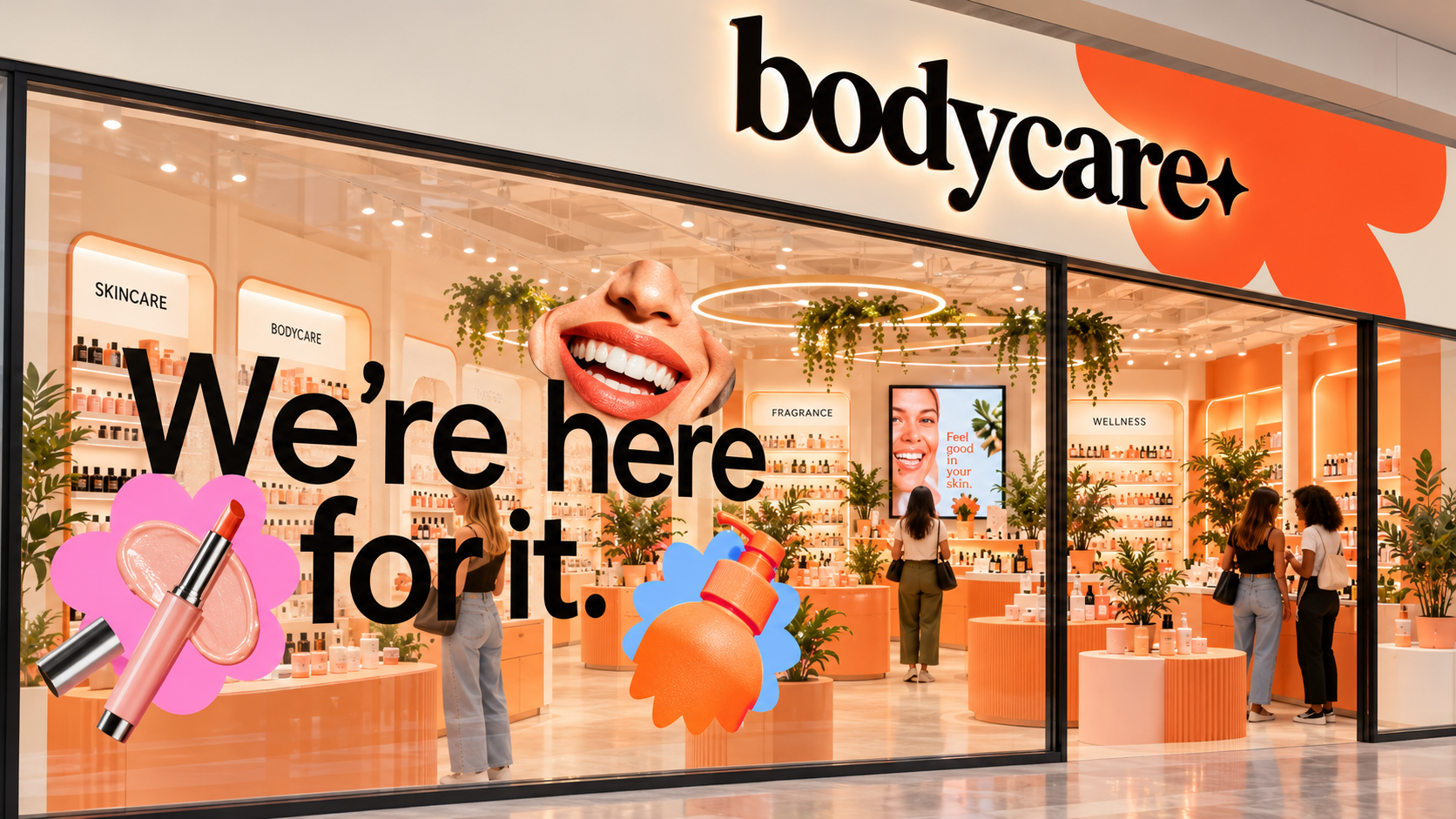
Is Bodycare Designing the High Street for TikTok First?
When was the last time you went into a shop because the shop itself was actually worth visiting?
Not because you needed toothpaste. Not because you were killing ten minutes. Not because your partner had disappeared into another shop and you’d given up trying to find them.
I mean because there was something about the experience you genuinely couldn’t get online.
That question has been rattling around in my head since I saw Bodycare’s new rebrand.
Because while plenty of retailers are still trying to work out how to drag people away from their phones and back onto the high street, Bodycare appears to have gone:
Why are we fighting the phone?
Bring it in.
Their new stores have spaces specifically designed for people to create content, film TikToks, go live and discover products in much the same way they already do online.
And I think that’s really interesting.
Not because I particularly want every shop I visit to turn into a content studio. I’m quite happy buying deodorant without accidentally appearing in somebody’s livestream.
But because Bodycare seems to have understood something a lot of retailers are still struggling with:
the internet hasn’t ruined physical shopping. It’s changed what a physical shop needs to be.
And that might be a much bigger idea than the rebrand itself.
A shop that expects you to get your phone out
Bodycare has relaunched with a new identity and store concept built around the way people increasingly discover products now: through creators, recommendations, social media and the endless scroll.
Every new store includes a creator space where customers and local creators can film content, use proper lighting and even broadcast live.
Normally, phrases like “social-first retail experience” make me slightly nervous.
They tend to mean someone has put a massive screen near the till, added a QR code and then used the word “immersive” far too many times in a presentation.
This feels different.
Bodycare seems to have started with an actual behaviour rather than a bit of tech.
People are already making content. People are already discovering products through creators. People are already using their phones in-store.
So instead of pretending that behaviour is a nuisance, the store is being designed around it.
That is a much more interesting idea.
Shopping does not start at the shop anymore
I can’t remember the last time I discovered something simply because I happened to walk past it on a shelf.
More often, you see something online first.
Somebody posts about it. Someone reviews it. Someone else tells you the first person is wrong. You save it. Forget about it. Then the algorithm shows it to you another six times because apparently subtlety is dead.
Then three weeks later you’re standing in a shop looking at the exact same thing and thinking:
“Oh yeah. That thing.”
That is how shopping works for a lot of people now, especially in beauty and fashion.
The physical shop is no longer always the start of the journey.
Sometimes it is just the point where the internet becomes real.
And Bodycare seems to understand that.
The scrolling idea is the bit I really like
The new layouts are designed around discovery, with products and categories appearing as customers move through the space in a way that has been compared with scrolling through a feed.
That makes sense to me.
Not because I think shops should literally become TikTok.
Please don’t.
Nobody needs to walk into a beauty shop and have twelve products dancing at them while a ring light follows them around.
But the idea of designing around discovery rather than simply organising everything into rigid departments feels smart.
Online, we are constantly being shown the next thing.
Then another thing.
Then something completely unrelated that somehow costs $180.
Physical retail has traditionally been much more static.
Here is skincare. Here is fragrance. Here are the tills. Good luck.
There is probably room for something in between.
The branding gets this right too
The old Bodycare sat comfortably in the world of traditional value retail.
Functional. Cheap. Practical.
Nothing wrong with that.
But value retail has a habit of ending up with a visual language that basically says:
“We saved money on the design too.”
The new identity feels brighter, more flexible and more connected to beauty culture.
What I like most is that it doesn’t suddenly pretend Bodycare is a luxury brand.
No beige. No tiny serif logo. No woman staring thoughtfully at a rock.
It is still a value brand.
It just seems to have realised that good value and good design are allowed to exist in the same building.
That distinction matters.
The AI bit might actually be the cleverest part
Behind the visual side of the relaunch, the new Bodycare model also uses data and AI to understand things like product trends, customer behaviour, stock and creator performance.
And this might be the most important part of the whole thing.
Because if that information genuinely changes what appears in store, then physical retail starts behaving a lot more like a digital platform.
Online stores constantly adapt.
Popular products move up. Recommendations change. Stock reacts. Content changes depending on what people are actually interested in.
Physical stores traditionally don’t.
They get fitted out, merchandised and then largely stay that way until somebody turns up with a clipboard and ruins everyone’s afternoon.
If a shop can become more responsive, that feels much more meaningful than simply making it look more “digital”.
But I’m not completely sold on the TikTok bit
This is where it gets tricky.
Designing a beauty retailer around creator culture makes complete sense.
Designing one too closely around a particular platform probably doesn’t.
TikTok is huge now.
That doesn’t mean the future of retail should permanently look like TikTok.
Platforms change. Behaviour lasts longer.
And I think that is the real lesson here.
The strongest part of Bodycare’s idea is not the creator studio itself.
It is the thinking behind it:
give people a reason to physically be there.
That sounds obvious, but a surprising number of shops still seem to think their main job is to hold products until somebody buys one.
If I can get exactly the same thing online, cheaper, without putting trousers on, you probably need to give me another reason to visit.
For Bodycare, that reason might be content creation, demos, discovery or piercing.
For someone else, it might be workshops, repairs, customisation, advice or events.
The execution changes.
The principle doesn’t.
Maybe the high street does not need saving
I always find it slightly odd when people talk about “saving the high street” as though the answer is convincing everyone to shop like it is 1997 again.
That is not happening.
People have changed. The way we find things has changed. The way we compare things has changed. The way brands become part of our lives has changed.
So the shops probably need to change too.
That is why Bodycare’s relaunch is interesting.
It does not treat the physical shop and the digital experience as two separate things.
The shop can create the content. The content can bring people into the shop. Creators can become part of the community. Customers can discover products online and then experience them in person.
The brand sits across all of it.
And, to me, that is what modern branding increasingly looks like.
It is not just the logo above the door. It is not the colour palette. It is not the packaging.
It is the reason somebody walks through the door in the first place.
And if Bodycare gets this right, the most interesting part of the rebrand might not be how the shops look at all.
It might be what people start doing inside them.