
Did AI Just Break Stock Photography?
What happens when an industry built around finding the right image suddenly lets you make one instead? What happens to a business whose entire value has been built around an enormous library of photography when a prompt can create something new in seconds? And is Getty Images heading for bankruptcy because AI finally broke stock photography?
That last question is obviously the interesting one.
Getty Images has announced that it plans to enter an expedited, prepackaged Chapter 11 process as part of a major financial restructuring. It is not disappearing, shutting down or suddenly taking millions of images offline. Getty says the business will continue operating as normal while the restructuring takes place.
But still.
Getty Images. Bankruptcy.
Those are two things I never expected to see sitting comfortably in the same sentence.
Getty has always felt enormous
If you work anywhere near design, advertising, publishing or marketing, Getty is one of those brands that just exists.
Need a photograph of a CEO shaking hands?
Getty.
Need somebody laughing suspiciously enthusiastically at a salad?
Getty.
Need an image from a football match that finished twelve minutes ago?
Also Getty.
For years, the process was completely normal. You needed an image, so you searched through a stock library, found the closest thing to what you had in your head, licensed it and moved on.
Getty became incredibly good at owning that moment.
And then the moment changed.
Now I can just describe the image
This is the bit I find fascinating as a designer.
The old problem was:
“Can I find the image I need?”
AI has changed that question to:
“Can I make the image I need?”
That is a massive shift.
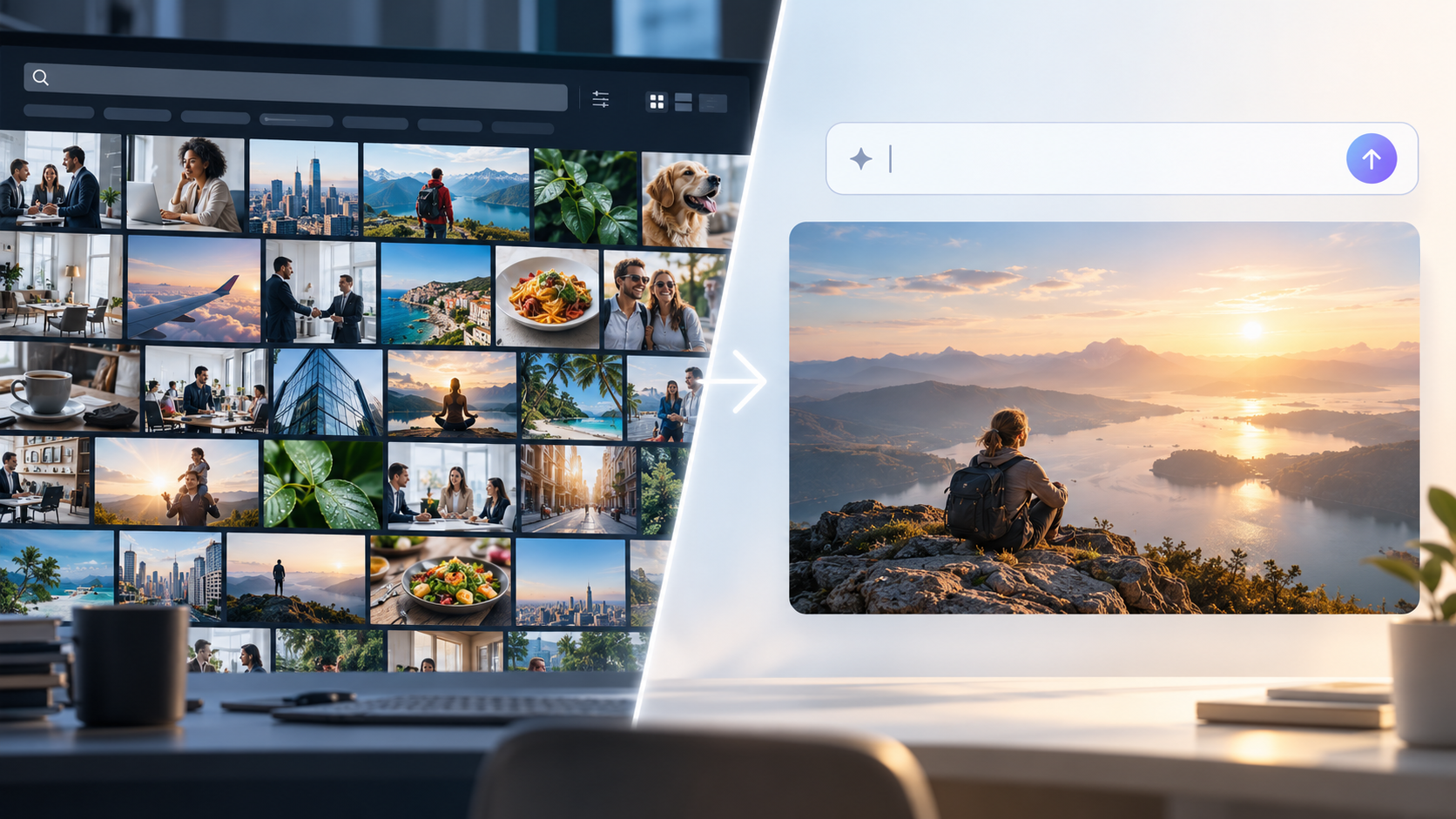
Instead of scrolling through twelve pages of “businessman pointing at laptop”, I can describe the composition, lighting, location, clothing, angle and mood I actually want.
And if the first image is wrong, I don’t necessarily go searching somewhere else.
I change the prompt.
That’s not just a new competitor for Getty.
It’s a completely different behaviour.
But AI isn’t the whole story
It would make a fantastic headline to say Getty is going bankrupt because everyone discovered Midjourney.
It would also be a bit lazy.
Getty has been carrying significant debt, reported at more than $1.3 billion earlier this year, and its planned $3.7 billion merger with Shutterstock collapsed after regulatory problems in the UK. The restructuring now includes up to $533 million in new equity from Getty family affiliates and Koch Equity Development, while holders of unsecured bonds have agreed to retire around $270 million of notes.
So this isn’t simply:
AI arrived. Getty died.
Far from it.
Getty was already dealing with a complicated financial structure.
But I don’t think you can ignore the timing either.
Because the value of an image has changed
For a long time, access was the product.
Getty had the library.
You didn’t.
Therefore the library had enormous value.
But generative AI has made certain kinds of imagery almost infinitely available.
Need an attractive couple sitting in a modern kitchen?
Generate it.
Need a generic construction worker?
Generate it.
Need a futuristic office, a happy family, a mountain landscape or somebody holding an absurdly clean cup of tea?
You get the idea.
A huge chunk of traditional stock photography exists to visually communicate fairly generic ideas.
And generic imagery is exactly where AI is frighteningly good.
The funny thing is, this might make real photography more valuable
This is where I don’t think the story is as simple as “photography is dead”.
Quite the opposite.
Getty’s archive contains things AI can’t genuinely recreate.
The goal that actually happened.
The politician who actually stood at the podium.
The actor who actually walked the red carpet.
The protest.
The war.
The Olympic final.
The moment everybody remembers.
Getty has built an enormous business around being there when those things happen.
That matters.
Because the more synthetic imagery fills our screens, the more important provenance becomes.
Did this actually happen?
Who took the photograph?
Can I trust it?
Suddenly those questions have value too.
So maybe Getty’s problem isn’t photography
Maybe it’s the middle.
At one end you have genuinely important, documentary imagery where authenticity is everything.
At the other end you now have generated imagery where control, speed and specificity are everything.
And sitting awkwardly between the two is traditional generic stock photography.
The perfectly diverse team pointing at a Post-it note.
The woman wearing a headset while giving a thumbs up.
The bloke in a suit standing triumphantly on top of a mountain for reasons nobody has ever fully understood.
That middle ground suddenly feels vulnerable.
I can already feel it in my own work
AI hasn’t stopped me valuing photography.
If anything, it’s made me think much harder about when photography matters.
If I’m creating something conceptual, AI can be brilliant.
I can explore a thought quickly. Build something surreal. Create an image that probably couldn’t justify a full photoshoot.
But if I’m telling the story of an actual business, person, product or place?
I’d still rather have the real thing.
A real photograph has imperfections.
It has context.
It happened.
And increasingly, I think that is going to become part of its value.
This feels bigger than Getty
That’s why I find this story interesting.
It isn’t really about whether Getty survives Chapter 11. This is a pre-agreed restructuring intended to take the company private and strengthen its balance sheet, and Getty says employees, contributors, partners and customers should continue unaffected.
The bigger question is what happens to the visual industry around it.
For decades we built an enormous ecosystem around finding images.
Photographers created them.
Libraries organised them.
Designers searched for them.
Brands licensed them.
Now we’re entering a world where finding the image and creating the image are becoming the same action.
That’s a fairly fundamental change.
And I don’t think designers should ignore it
There’s a temptation with AI to reduce everything down to an argument about whether it’s good or bad.
I don’t find that particularly useful.
It’s here.
People are using it.
Our job is to understand what that changes.
Getty’s restructuring feels like another reminder that technology rarely destroys everything in its path equally.
It makes some things cheaper.
It makes some things easier.
And sometimes, by doing that, it makes the things it can’t replace even more valuable.
Maybe generic stock photography becomes less important.
Maybe authentic photography becomes more important.
Maybe Getty eventually becomes less about giving us an image and more about proving that an image represents something real.
Because in a world where we can create almost any picture we want, the most valuable image might eventually be the one we know actually happened.
Sources: Getty Images / SEC filing, The Verge, Axios.