
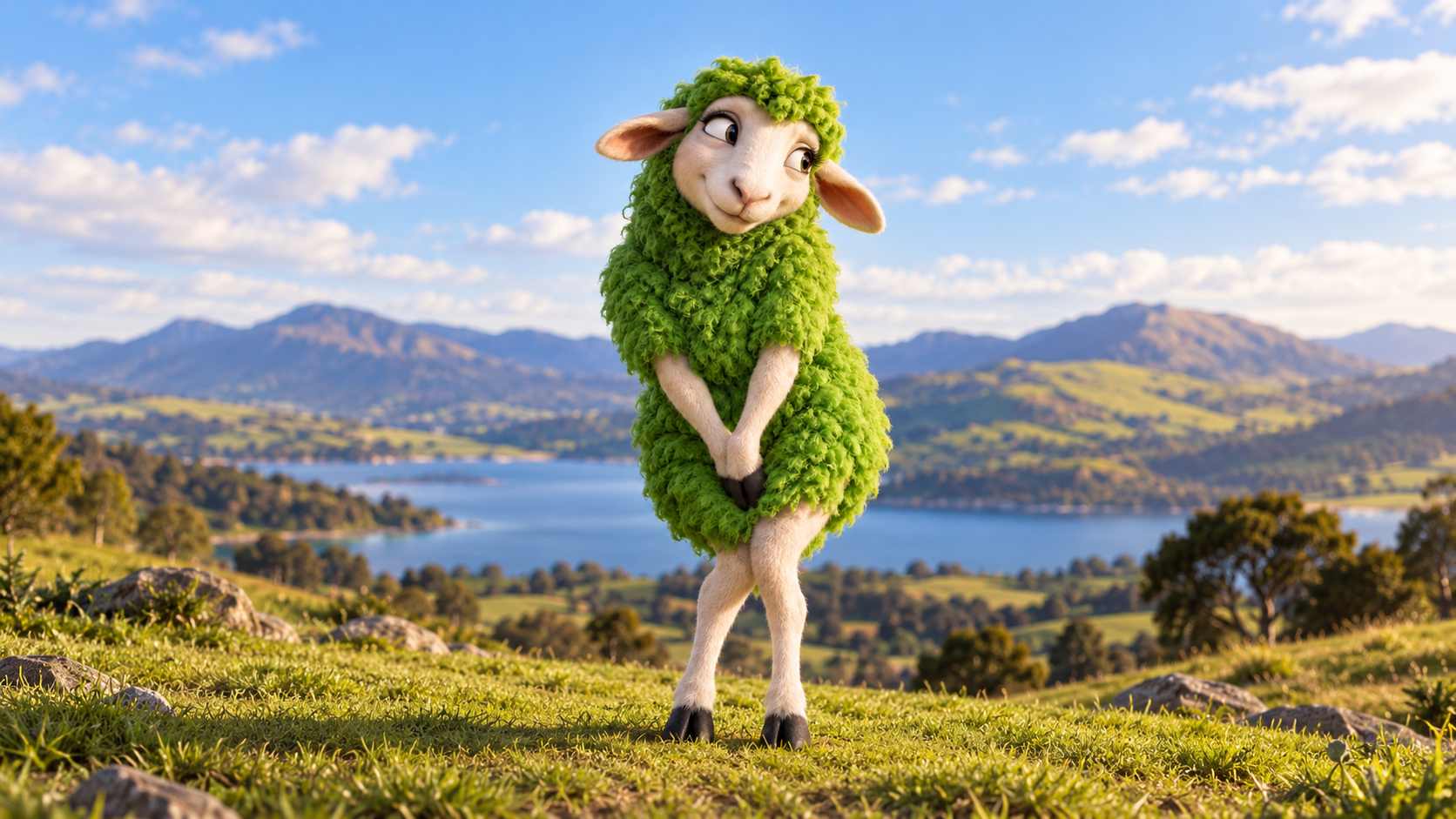
How Did a Green Sheep Become Sexy?
How does a bank launch a green sheep and somehow end up with the internet asking whether they’d sleep with it? How does something created to make financial services feel a bit more memorable become a questionable crush? And at what point does someone in marketing have to say, with a completely straight face, ‘We need to talk about Buck’?
Kiwibank created Buck to stand out from the flock. A green sheep. Simple idea. Sheep follow. Buck doesn’t. Kiwibank wants to be the bank that does things differently. It’s actually a really smart bit of branding because the idea is clear almost instantly.
Then the internet found it. And, as usual, the internet behaved exactly like the internet.
What started as a brand mascot suddenly became memes, fan art, jokes and a level of attention that I’m fairly sure was not covered in the original campaign deck. Somewhere, someone looked at Buck and effectively asked, ‘Would you?’
That is a difficult moment for any brand team.
This probably wasn’t in the presentation
You can imagine the original meeting. Buck represents individuality. Buck challenges convention. Buck gives Kiwibank a distinctive character. Buck helps the brand stand out in a category full of fairly serious financial institutions.
All very sensible.
What I doubt anyone said was, ‘We should probably prepare for the possibility that people find the sheep attractive.’ Because until recently, that was one of those risks you could comfortably leave off the spreadsheet.
There were probably guidelines covering how Buck moves, how Buck appears beside the logo, what expressions Buck can make and what sort of situations Buck should appear in. There probably wasn’t a page titled Please do not sexualise the sheep.
A simpler time.
This is the problem with making something people actually notice
Brands always say they want engagement. They want people to talk about the campaign. They want comments, shares and reactions. They want the work to become part of culture rather than just sit there politely asking to be noticed.
Then people actually start talking about it and suddenly it becomes: ‘No, not like that.’
That is the tricky bit. You can control the campaign while it is inside the agency. You can control the final artwork. You can control the logo spacing, the approved colours, the animation and every last bit of wool.
The second you put it into the world, you lose some of that control. People will interpret it however they want. And sometimes they will interpret it very, very strangely.
The annoying thing is that it worked
You remember Buck. I remember Buck. Loads of people who probably could not tell you Kiwibank’s latest mortgage rate remember Buck.
That matters.
Most bank advertising is incredibly easy to forget. You see a smiling couple standing outside a house, somebody mentions a fixed rate, there is a bit of uplifting music and your brain quietly deletes the whole thing before the ad has finished.
Buck didn’t get deleted. Buck became a thing. A slightly inappropriate thing, perhaps, but still a thing.
And getting people to remember a piece of advertising is difficult enough before the audience starts discussing whether the central character is sexy.
The funniest part is that Buck is behaving exactly as intended
Buck is supposed to be the sheep that does not follow the flock. That is literally the idea.
Then Buck gets released into the world, ignores all normal expectations, wanders off into the internet and becomes a minor cultural incident. You could almost argue that it is the most successful expression of the brand idea possible.
The sheep refused to follow the flock so convincingly that even the campaign team could not keep up.
That is commitment to the concept.
Banks are not supposed to be sexy
This is worth pointing out. Mortgages are not sexy. Interest rates are not sexy. Term deposits are not sexy. Nobody has ever looked at a home loan rate and whispered, ‘Steady on.’
Financial services are useful, important and generally about as seductive as reading the terms and conditions on a toaster warranty.
So the fact that Kiwibank managed to create anything that people could describe as sexy is, in its own strange way, impressive. Possibly not the intended KPI. But a KPI nonetheless.
There is a lesson in this somewhere
A good brand gets recognised. A great brand gets remembered. And every now and then, a brand becomes interesting enough that people start doing things with it the original creators never expected.
That is the uncomfortable part of making something people genuinely care about. You lose a little control. They remix it. Mock it. Love it. Misunderstand it. Make it weird.
But the alternative is far worse. Nobody noticing at all.
Kiwibank wanted a sheep that stood out from the flock.
They got exactly that.
They just probably did not expect the flock to fancy it.