
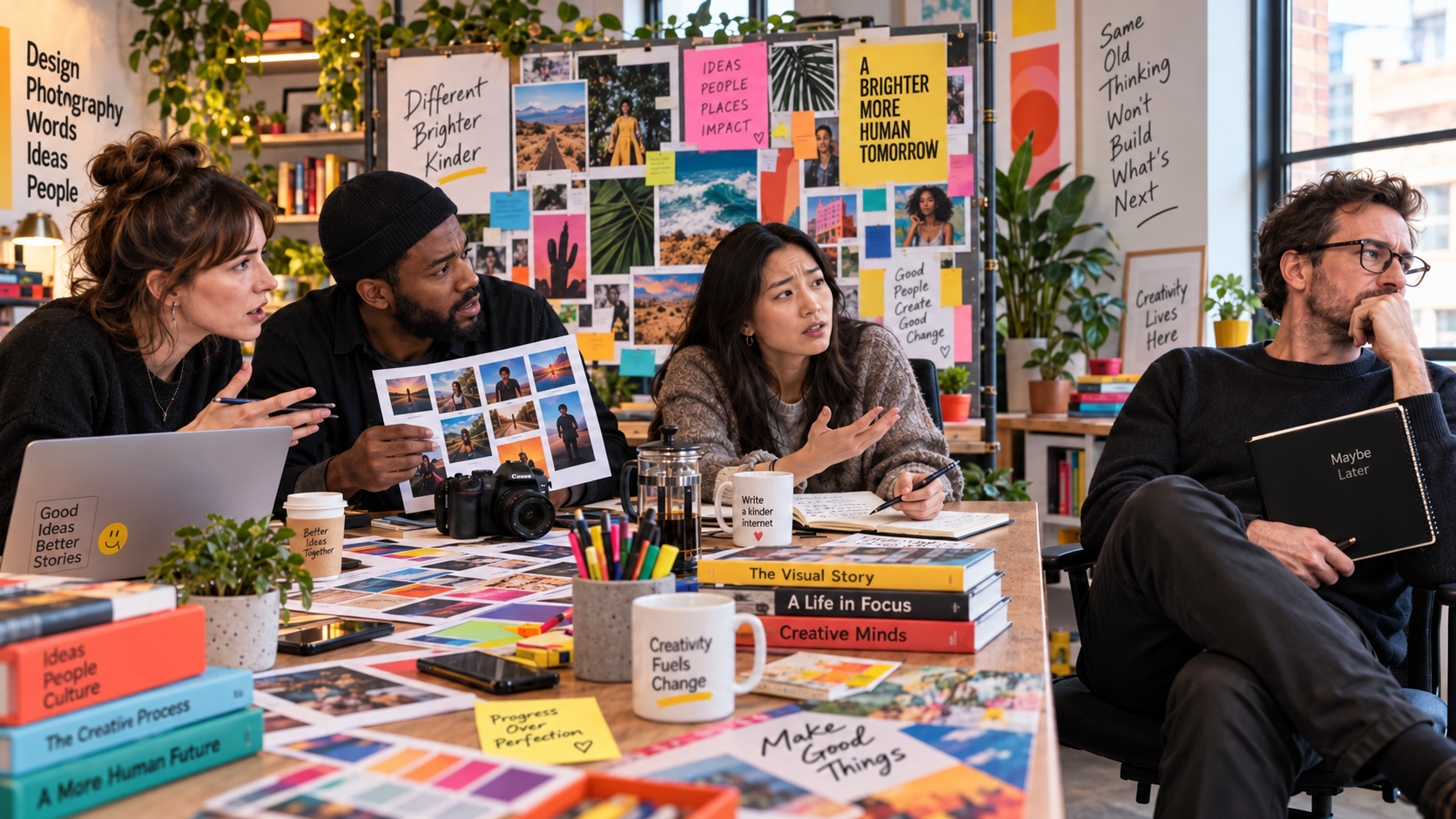
Great Work Can Still Go Badly Wrong
You can put brilliant people in a room, give them a healthy budget, all the right tools and enough tea to keep a small airport running.
And still end up with something completely average.
I’ve seen it happen.
Talented designers. Great photographers. Good ideas. Plenty of effort.
Then somehow the final thing comes out flatter than it should.
Not because anyone wasn’t good enough.
Because nobody was really joining the dots.
And that, for me, is what creative direction is actually about.
I used to think the job was mostly visual
When I was younger, creative direction seemed pretty straightforward.
Set the standard. Pick the strongest route. Make sure the work looks right. Push it until it feels finished.
And yes, that’s part of it.
But the longer I’ve worked across branding, websites, campaigns, photography, products and everything else that somehow finds its way into a creative project, the more I’ve realised the job is much bigger.
A brand doesn’t live in one advert anymore.
It lives everywhere.
On the website. On social. In packaging. In presentations. In emails. In recruitment. In customer service. In the PowerPoint someone made at 11:47pm because they “just needed something quickly”.
Every one of those things can look perfectly reasonable on its own.
And together they can still feel like five different people trying to tell the same story after being given five different scripts.
That’s where the trouble starts.
Nobody has to make a bad decision
That’s the strange thing.
Marketing can make a perfectly sensible call. Sales can make a perfectly sensible call. Social can make a perfectly sensible call. Product can make a perfectly sensible call.
And six months later, the brand looks like it’s been through a washing machine with somebody else’s clothes.
It rarely falls apart because of one huge mistake. It usually happens through tiny compromises.
A different font here. A new colour there. A different photography style. A bit of copy that suddenly sounds like it came from another company.
Nothing feels catastrophic.
Until you stand back and realise you don’t recognise yourself anymore.
Creative direction is partly about being the person who asks:
Does this still feel like us?
Simple question. Not always a simple answer.
Good creative direction should make people better
There’s a version of creative direction that involves standing behind somebody and telling them to move things two pixels left.
That’s not creative direction.
That’s just being annoying professionally.
Good creative direction should give people clarity.
If a designer understands the idea, they can make better decisions without constantly asking permission. If a photographer understands the feeling, they can spot something brilliant on the day that wasn’t in the shot list. If a writer understands the personality, they can push the copy further without losing the brand.
The goal isn’t to control everything.
It’s to give everyone enough confidence to contribute.
Because talented people usually don’t need somebody telling them exactly what to do.
They need to know what they’re trying to achieve.
Creative direction without trust is just micromanagement wearing nicer shoes.
You don’t need to have the best idea
This one took me a while to learn.
When you’re responsible for the creative, it can feel like you’re supposed to have the answer.
You’re not.
Sometimes the designer has the better idea. Sometimes the photographer spots something you completely missed. Sometimes someone who isn’t even part of the creative team says something in a meeting and suddenly the whole thing makes sense.
The job isn’t to be the cleverest person in the room.
The job is to recognise the good idea when it turns up.
Then help it survive.
A good creative director shouldn’t be the loudest person in the room. They should be the reason everyone else sounds better.
Good direction saves money
Creative direction can look expensive if you only see it as another person in the process.
But bad direction gets expensive very quickly.
More rounds. More meetings. Reshoots. Unused photography. Designers rebuilding things because the brief wasn’t clear. Campaigns that look perfectly fine and disappear from everyone’s memory five minutes later.
The expensive part isn’t paying someone to direct the work.
The expensive part is paying everybody else to fix it afterwards.
A clear decision at the beginning can save ten messy decisions later.
That’s not glamorous.
But neither is paying for the same thing twice.
Good ideas need protecting
One thing I’ve seen plenty of times is a good idea slowly being made more reasonable.
And reasonable can be dangerous.
Someone suggests a small change. Then another. Then another.
Nobody means to kill the idea. They’re just trying to make it safer.
But little by little, the interesting bit disappears. The strange bit goes. The thing that made you stop and look starts feeling a bit too risky.
Eventually you’re left with something everyone agrees is “nice”.
And “nice” is where a lot of good ideas go to die.
Sometimes an idea feels uncomfortable because it’s wrong.
Sometimes it feels uncomfortable because it’s new.
Knowing the difference is a huge part of the job.
Sometimes leadership means getting out of the way
This might be the bit I believe most.
You don’t always help by adding something.
Sometimes you help by not adding anything at all.
Let the designer run with it. Let the photographer try something. Let the writer find the line.
Give people enough room to surprise you.
There’s a strange confidence in being able to say:
“That’s better than what I had in mind. Let’s do that.”
I think that’s leadership.
Not needing your fingerprints on every idea.
Just caring that the final thing is the best it can be.
Sometimes the best thing you can bring to a creative team isn’t another idea. It’s enough confidence to let someone else’s idea breathe.
The job is bigger now
Creative direction isn’t just visual anymore.
It has to connect what a business says with how it behaves.
You can’t tell people you’re simple and easy to deal with if the experience feels complicated.
You can’t call yourself premium if every interaction feels rushed.
You can’t spend years talking about being different while slowly making yourself look exactly like everyone else.
Eventually, all those little things add up.
That’s the job.
To make sure they add up to the right thing.
Join the dots
The longer I’ve worked in design, the less I think creative direction is about being the person with all the answers.
It’s about seeing the whole picture.
Recognising the best idea.
Protecting it when it needs protecting.
Giving people the confidence to make it better.
And knowing when to get out of the way.
Because talent matters. Craft matters. Budgets matter.
But none of them guarantee good work.
Sometimes you can have all the right ingredients and still make a terrible cake.
And if that happens, blaming the flour probably isn’t going to help.
Someone has to look at the whole thing.
Someone has to keep everyone moving in the same direction.
Someone has to Join The Dots.