
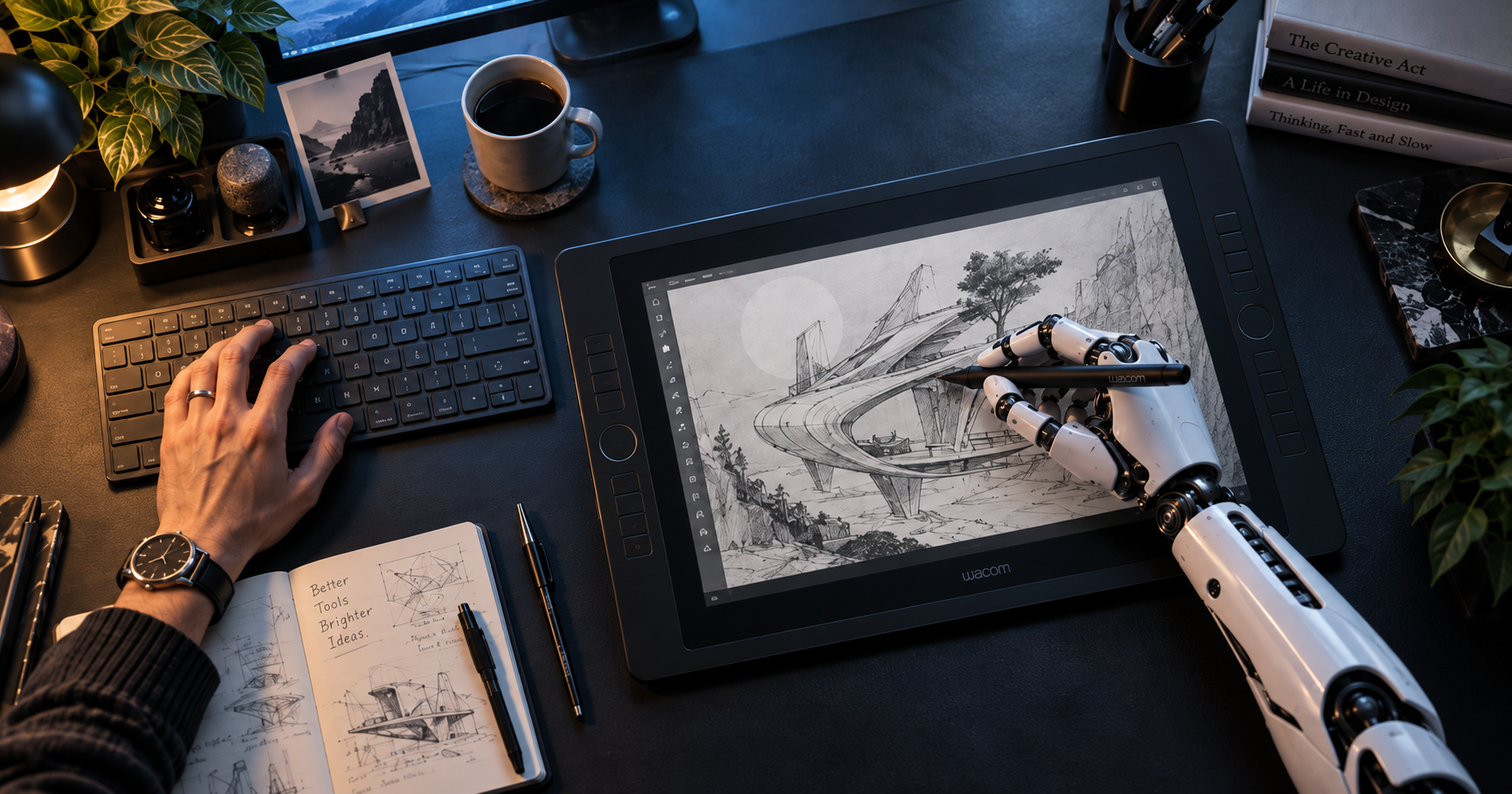
AI Isn’t Replacing Designers. It’s Changing What We Value: Good Thinking
AI Isn’t Replacing Designers. It’s Changing What We Value: Good Thinking
I use AI pretty much every day now. And strangely, the more I use it, the less convinced I am that it’s going to replace good designers.
It might replace a few things designers currently spend their time doing. In fact, I hope it does. There are plenty of parts of my working day I’m quite happy to hand over. Resizing things 14 times? Fill your boots. Removing something from the background of an image? Crack on. Generating twenty starting points so I don’t have to stare at a blank page? Lovely.
But deciding what something should look like…? That’s different.
AI has changed my starting point
For years, starting a design meant gathering references, sketching, searching, experimenting and eventually stumbling across something that felt interesting enough to pursue.
I still do all of that. The difference is that AI has massively increased the amount of territory I can explore.
I can throw a stupid idea at it. Then a sensible one. Then ask it what happens if the stupid idea and sensible idea have a baby. Within minutes I can see directions that previously might have taken hours to mock up. That’s incredibly useful.
But there’s a problem.
AI will happily give you 100 ideas. It has absolutely no embarrassment about giving you 99 terrible ones. That’s where being a designer becomes important.
The valuable bit isn’t making things
For a long time, a big part of being a designer was knowing how to physically make the thing.
Photoshop, Illustrator, Indesign, Cinema 4D., After Effects.
Whatever tool was required to get what was in your head onto a screen. Those skills still matter. But access to production is becoming easier incredibly quickly.
Someone who has never opened Photoshop can now describe an image and receive something that would previously have required a photographer, studio, retoucher and half a day arguing about whether the shadow should be softer.
That changes things.
The bit I think becomes more valuable is knowing what to ask for in the first place.
Knowing when something feels wrong. Knowing when an idea is obvious. Knowing when to stop. Knowing which one of 50 options actually has something in it.
That is taste.
And taste is difficult to automate.
AI is very good at average
This is probably the thing I notice most.
Ask AI to create a premium skincare brand and it’ll create a perfectly respectable premium skincare brand.
Neutral colours, elegant serif, beautiful bottle., lots of beige.
Job done.
The problem is that it looks like every other premium skincare brand.
The same happens in architecture, interiors, advertising, branding and photography.
AI has consumed an enormous amount of what already exists, so naturally it is very good at producing something that feels like what already exists.
That’s useful when average is the target.
It isn’t particularly useful when you’re trying to create something people remember.
As designers, I think our job is increasingly going to be pushing against that gravitational pull towards sameness.
It has made me faster, but hopefully not lazier
This is the bit I’m conscious of in my own work. AI makes it incredibly easy to skip the uncomfortable stage. The bit where nothing is working. The sketches look rubbish. You don’t quite know what you’re looking for.
Historically, you had no choice but to sit in that discomfort until something appeared. Now you can type a sentence and receive six shiny things immediately. That feels productive and it sometimes it is.
Sometimes you’ve just polished the wrong idea incredibly quickly.
So I’ve started thinking of AI less as the designer and more as another person in the room.
A very fast person. Slightly strange. Has read virtually everything. Occasionally makes things up. Never needs lunch. Useful, but probably shouldn’t be left alone.
It’s changed the way I work at PKO
For PKO, AI lets me do more with the time I’ve got.
I can explore more visual directions. I can build mock-ups quicker I can test an idea before committing hours to it. I can use it to challenge copy, question an approach or ask whether I’m missing something obvious.
That’s the bit I find genuinely exciting.
It hasn’t removed the design process. It has made the process bigger. I can get further into an idea before deciding whether it’s worth pursuing. And if it isn’t? Fine. Bin it. There’s another one five minutes away.
So am I worried?
A little bit, yeah!
Anyone saying AI won’t affect design jobs is kidding themselves. Of course it will.
Technology has always changed creative industries and this one is moving ridiculously quickly.
But I don’t think the answer is to stand outside shouting at the robots. I’d rather learn how to use them. The designers, I think will do well, are the ones who can combine the speed of AI with all the messy human stuff AI struggles with. Curiosity. Humour. Experience. Empathy. Context. Taste.
And the ability to look at something technically perfect and say:
“Yeah. But it’s a bit shit, isn’t it?”
That might end up being one of the most valuable design skills we’ve got.